A kangaroo court — in your home — that you pay for.
If you're a condo owner, you probably assume there are rules to protect you — that if something serious goes wrong, there's a straightforward process to fix it. But what happens when the very people entrusted to help — your board and property manager — instead obscure, delay, or outright deny the problem?
This is my story. But it's not just about me. It's about how a system that's supposed to safeguard owners can break down — and how even doing everything "right" doesn't guarantee accountability unless you're willing to fight for it or be ready to call the police instantly.
The Building and the Management
I live in a loft building in the West Loop of Chicago, a 189-unit condominium building managed by FirstService Residential (FSR). This Canada-based company is one of the largest condo association management firms in the United States. Its parent company, FirstService Corporation, is publicly traded on the NASDAQ. Like many residents, I expected the board and FSR to act in our best interests — not only because their regional managers, onsite property managers, and executives are licensed professionals legally obligated to do so, but also because… isn't that the job? To maintain safety, follow the rules, and resolve serious issues when they arise?
But that's not what happened in my experience.
One of the Incidents
In 2023, I had a disturbing confrontation in the lobby of my building with our onsite manager, an FSR employee. This came after he sent me an email in all caps — "LOL COLIN!!!!" — which, sadly, was not meant humorously as far as I can tell. In my opinion, I was assaulted. He yelled at me in front of other employees, and as I walked away to de-escalate the situation, he turned and continued screaming as I passed him. When I later asked about security footage, I received multiple contradictory responses: first, that footage is retained for more than 14 days; then, that no footage existed; and finally, that the system had been working that day and footage should have been available for at least 15 days. These shifting explanations raised serious red flags. The regional supervisor from FSR then "investigated" the incident herself — evaluating her subordinate — with no board involvement, transparency, or independent oversight.
Ultimately, the board concluded that the employee had done nothing wrong. It stated the onsite manager "…was not found to violate our managing agreement nor any other governing authority of the Association." Accusations of assault? Conflicting and possibly missing security footage? All fine.
Under Illinois law, assault is defined as "conduct which places another in reasonable apprehension of receiving a battery" (720 ILCS 5/12-1).
To make matters worse, FSR had failed even to make available the formal complaint form required under our governing documents. I had to independently track down the onsite manager's supervisors to raise the issue. I remember finding a super helpful blog post written by a Chicago-based attorney (I spent half an hour trying to find it again — I could've sworn I saved it in OneNote. It was a female lawyer with an office in the Loop. Comment below if you know who I'm talking about!) and I'm still incredibly grateful she took the time to write it. That post led me to the Illinois condo code — clear: the Ombudsman complaint form is required, and it exists precisely so unit owners can formally reach the board and need a response.
The form technically existed for my building but was not publicly accessible. I had to cite the relevant Illinois statute and directly send it to FSR employees to get a copy. Only after that did they finally upload it to our resident portal — and just yesterday, after countless follow-up emails, they printed physical copies for the front desk. Now, not just me but all residents can easily access the form and contact the board directly instead of relying on the onsite manager and hoping he passes the message along.
The Insurance Claim That Vanished
After more of the same — more yelling and another refusal to provide access to security footage — I escalated the issue further. This time, it wasn't the onsite manager's supervisor who blocked access, but her supervisor, who replied, "I received your communication," and made no footage available. This made no sense to me. Security footage is maintained for the association, and I am part of that association as a unit owner. Why should I be denied video evidence of a disturbing incident involving an FSR employee?
Under Illinois law, unit owners have the right "to inspect, examine, and make copies of the records of the association" upon written request (765 ILCS 605/19(a)). The law further specifies that these records include those "relating to the operation and management of the association." While security footage isn't mentioned explicitly, if it exists and relates to a dispute or incident involving a managing agent, it falls under this provision. Refusing to provide access — especially without explanation — raises serious concerns about transparency, accountability, and whether the board is fulfilling its legal obligations.
Adding to the concern, many of FSR's senior staff hold respected industry designations (CMCA, AMS, PCAM, CPM). But how is blocking access to basic evidence — like security footage — in the best interest of an owner or the association? If there's nothing to hide, show the tapes. OJ didn't throw the gloves away because they didn't fit.
I filed a claim with the building's Directors & Officers (D&O) insurer, CNA. The insurer began reviewing the matter and, notably, never denied the claim. Instead, the board chose to withdraw it — meaning, according to the claims adjuster (who has since left CNA), the board assumed full liability. As a unit owner acting not just in my interest but in the best interest of all residents, I struggle to understand how a condo board voluntarily assuming liability for a valid insurance claim serves the association.
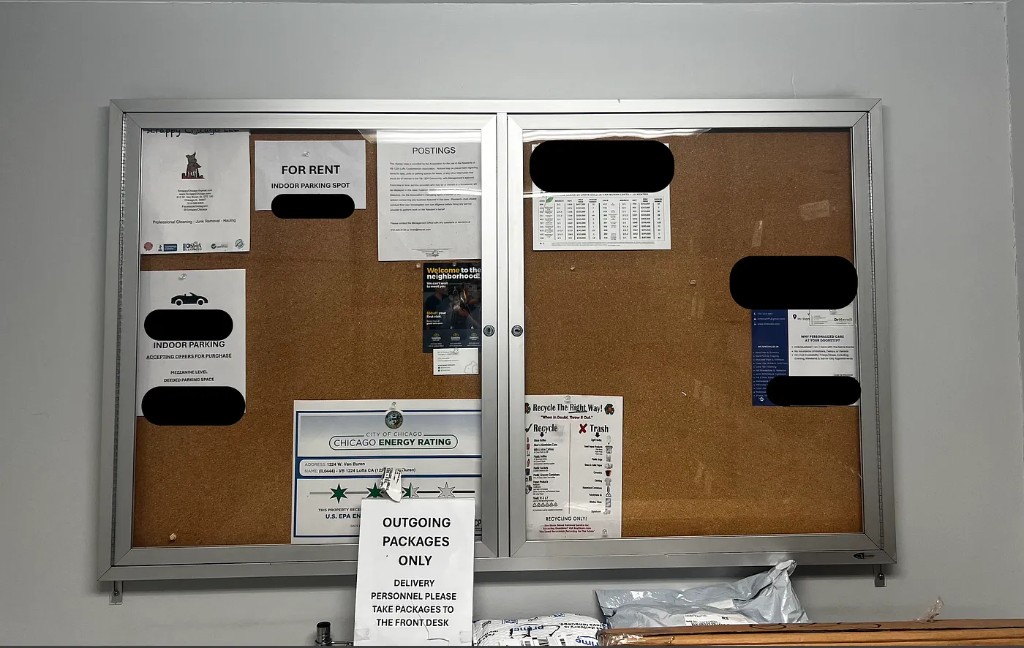
When I learned that the board had withdrawn our D&O insurance claim without informing other residents, I made a poster outlining the potential risks to our building's reserve funds. I posted it on the community bulletin board, which already had items like parking ads and business cards. However, the building manager responded — not the board — stating that "the Board has not approved your posting and will not be displayed until they review it and direct me accordingly." He then never emailed me about the poster again. That response completely missed the point. This wasn't a personal gripe — it was an attempt to inform fellow owners that our shared reserve funds might now be exposed to legal liability. Blocking that message while allowing other ads to remain posted shows a double standard. It raises the question: whose interests are being protected?
File Suit?
After months of delays, denials, and dismissals — despite clear evidence, documented incidents, and multiple formal complaints — I was ultimately left asking myself: what else could I do?
I discovered that my experience wasn't unique. A quick search revealed countless reviews and complaints from residents of other buildings managed by FirstService Residential. Here's just a sampling of what others have said:
Better Business Bureau
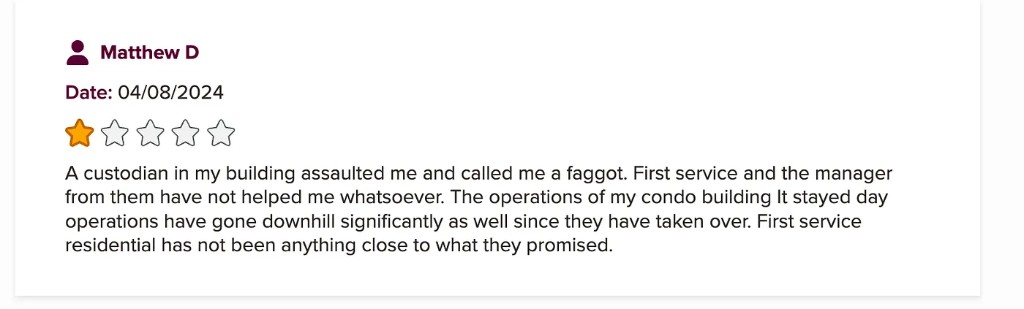
FirstService Residential has 18 reviews, an average of one out of five stars.
A sample review (sorry for the slur featured in the review, but it seems even more extreme than my experience and speaks to what I consider a clear pattern of behavior — also an allegation of assault; I am not alone):
Click here to see more Better Business Bureau reviews
Yelp
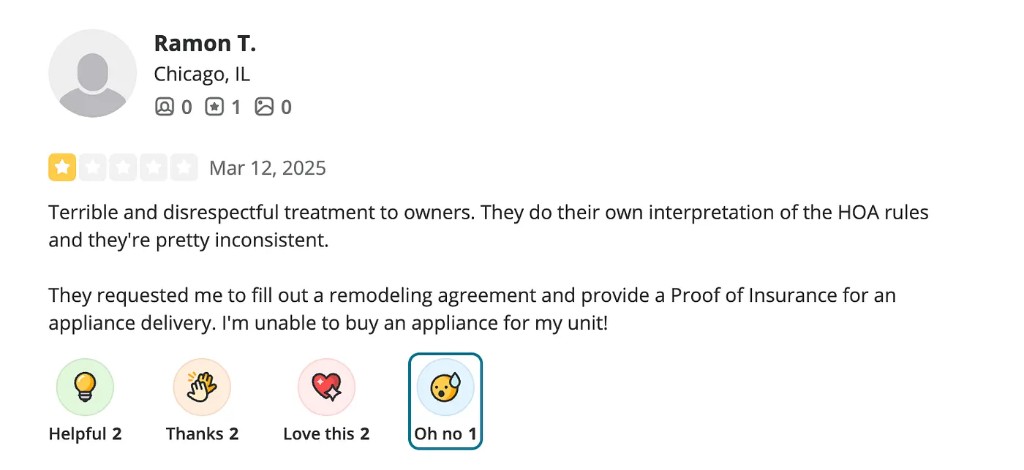
FirstService Residential has 170 reviews on Yelp, with an average rating of 2.4 stars.
Click here to see more Yelp reviews
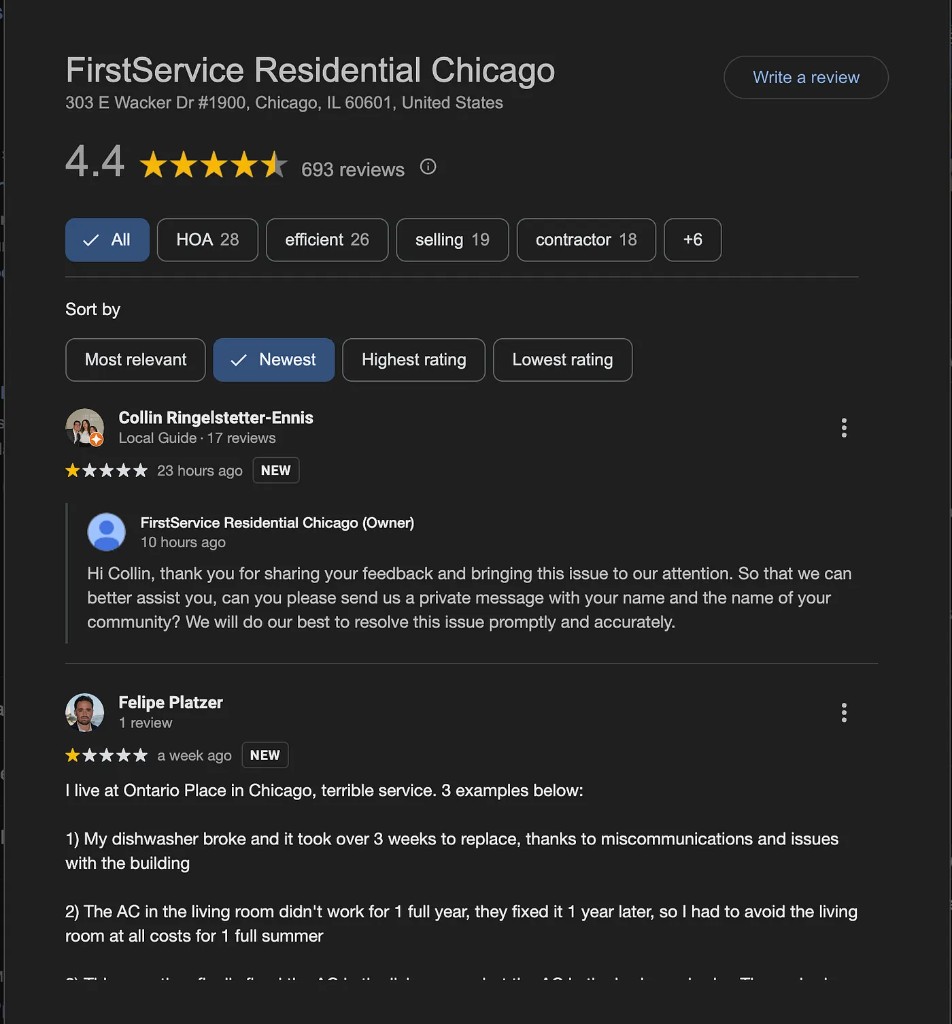
The Google reviews are oddly higher, and I question if they are from an email prompt they sent out soliciting reviews — the five-star reviews all come from the same period, with the most recent reviews showing similar stories to mine. Sort by date to see what I mean:
Click here to see more Google reviews
These public reviews paint a troubling picture that aligns closely with my experience: management companies and condo boards repeatedly sidestepping responsibility, leaving individual owners with nowhere else to turn.
I never wanted litigation. I initially trusted that my board and FSR would resolve the issue responsibly. Instead, I faced a withdrawn insurance claim and the association quietly assumed liability for a legitimate, unresolved dispute.
This raises an essential question for all condo owners: is it appropriate — or even legal — for a condo board to assume liability for a valid insurance claim, forcing an owner into the difficult position of having no choice but to file a lawsuit?
Condo owners deserve answers. We deserve transparency. And we certainly deserve better — after all, we own the property, not FirstService Residential or the condo board alone.
Current State
Since the board withdrew the claim:
- The insurance claims adjustor has left CNA and now works at a different firm.
- The FSR Regional Manager has left the company.
- The onsite manager has been relocated to a different FSR-managed building.
The board renewed its contract with FirstService Residential without getting a single competitive bid — one of the highest line items in our building's budget.
A Final Thought
I've chosen not to name individual employees or board members because this is about the system, not one person.
Why is a Canadian-headquartered company one of the largest HOA property managers in the United States? FSR bought the management company that previously managed my building, and has done this with other smaller management companies in the Chicagoland area. There are a number of independent HOA management companies in Chicago. Would my fellow residents and I be better served spending our dollars on local businesses?
Even after all of this, my condo board chose to renew its contract with FirstService Residential without getting a single competitive bid — one of the highest line items for my building when adding the cost of the onsite manager — roughly $80K plus over $3K a month to FSR for the items in the contract.